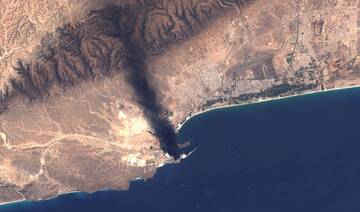



New Delhi: India’s expanding partnership with Oman offers Delhi an alternative route for crucial imports amid supply disruptions caused by the closure of the Strait of Hormuz, experts said on Friday, as a free trade pact between the two countries went into effect earlier this week.
Under the India-Oman Comprehensive Economic Partnership Agreement, India will export most of its goods without paying tariffs, covering about 99 percent of the total value of India’s exports to Oman.
While lower tariffs and improved trade rules are expected to help Indian businesses remain competitive, the pact that came into force on Monday arrives as energy supplies from the Middle East remain disrupted following US-Israeli attacks on Iran on Feb. 28.
“The coming into force of the CEPA between India and Oman has immediately gained significance due to the crisis in the Middle East and the closure of the Strait of Hormuz, through which massive chunks of energy and trade flow,” said Anil Wadhwa, former Indian ambassador to Oman and a distinguished fellow at the Vivekananda International Foundation.
“For India, this agreement is about securing its future when the ground beneath global supply chains is shifting.”
Though India has launched diversification efforts, it still depends on the closed Strait of Hormuz route for about 30 percent of its crude and 90 percent of its LPG imports.
In a statement, India’s Ministry of Commerce and Industry said that Oman’s strategic ports at Sohar, Duqm and Salalah will provide Indian exporters with “enhanced access” to the wider Gulf region and East African markets, as the CEPA is expected to “energize a new trade gateway.”
The pact gives India a number of practical tools, including alternative logistics, a friendly transhipment base, investment linkages, and a trade partner that can keep corridors open, Wadhwa told Arab News.
While the agreement may not “fully insulate India from the macroeconomic shock of a major regional war or act as a substitute for comprehensive naval and diplomatic strategies,” it still plays a significant and timely role.
“In the 21st century contest between commerce and conflict, geography still matters, and agreements such as these amplify the advantages therein,” Wadhwa said.
“This agreement sets a historic precedent and turns it into a modern buffer and bridge, shielding Indian trade from immediate regional spillover, all while broadening access to the markets that matter most to India’s economic ambitions.”
The pact is the second such trade agreement with a GCC country after a 2022 CEPA with the UAE. For Oman, it is the second such bilateral deal after the Oman-US free trade agreement signed in 2006.
Oman is India’s second-largest trading partner in the Gulf, with bilateral trade valued at more than $11 billion in the 2025-26 fiscal year.
The strategic pact not only boosts India’s manufacturing and engineering exports, but helps to diversify “supply chains away from the Strait of Hormuz and cements India’s geopolitical foothold” in the Gulf, said Manish Mohan, a senior director at the Confederation of Indian Industry.
“The sustained blockade of the Strait of Hormuz has triggered wider macroeconomic worries. And of particular concern is India’s high dependence on imported fuel, fertilizer and key industrial input items, while the higher freight cost continues to impede trade flows to West Asia,” he told Arab News.
India, the world’s second-largest fertilizer consumer after China, uses more than 60 million tonnes annually. The war on Iran has impacted the country’s domestic production of urea and fertilizer imports, as the Gulf accounts for about a third of its urea and phosphate fertilizer imports.
“The deal with Oman would offer India, you know, a better access, alternate access, to all our imports,” Mohan said.
“Because of the virtue of its location outside the state of Hormuz, Oman is seen as a … critical gateway … even if the conflict continues.”