


LONDON: Even as diplomats search for a way to end the war between Israel and Hezbollah, a medieval fortress in southern Lebanon has become one of the conflict’s most potent symbols.
Recent talks in Washington between Israeli and Lebanese officials produced the outline of another deal, one that Lebanese President Joseph Aoun described as “the last chance to enter into a final, comprehensive ceasefire.”
The proposed agreement would require Hezbollah to halt attacks on Israel and withdraw from southern Lebanon, while the Lebanese army would assume control of territory long dominated by the Iran-backed group.
Yet the gap between diplomatic aspirations and military realities remains vast.
Hezbollah’s leader Naim Qassem on Thursday rejected the conditional truce, demanding instead a comprehensive ceasefire and full Israeli withdrawal as he threatened northern Israel with new attacks.

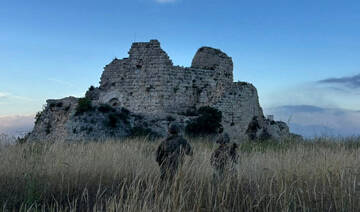
Prime Minister Benjamin Netanyahu declared: “We returned to Beaufort stronger than ever.” (Israeli Army/AFP)
“The ceasefire must be comprehensive ... without the Israeli enemy having the freedom to kill,” Qassem said, urging the government to halt “the farce and humiliation called direct talks” with Israel.
He also vowed that “as long as our villages are unsafe — being bombed, destroyed and our people killed — the settlements (north Israel) are unsafe.”
Israeli officials have made clear that military operations will continue while negotiations proceed. Hezbollah has vowed to keep fighting. Iran insists that any settlement must include a full Israeli withdrawal from Lebanese territory.
And across southern Lebanon, airstrikes, drone attacks and ground operations continue despite repeated efforts to halt the fighting.
Few places illustrate that contradiction more clearly than Beaufort Castle, a 900-year-old fortress that has once again found itself at the center of a war that has already claimed thousands of lives and displaced more than a million people.
The recent seizure of the castle by Israeli forces was celebrated in Israel as a symbolic milestone. Prime Minister Benjamin Netanyahu declared: “We returned to Beaufort stronger than ever.”
“Our brave fighters captured the Beaufort outpost. They proudly raised the flag of the State of Israel and the flag of the Golani Brigade there.”
The imagery was carefully crafted. Footage released by the Israeli military showed troops raising flags over the ancient fortress, while drone footage of the site circulated widely online.
For Israeli leaders, the operation appeared intended to demonstrate both military momentum and a determination to push Hezbollah away from the border. But for many Lebanese, the images conveyed a different message entirely.

Beaufort Castle’s military value today is open to debate. (AFP)
The castle, known in Arabic as Qalat Al-Shaqif — the Castle of the High Rock — sits roughly 15 kilometres west of the Israeli border on a rocky ridge overlooking the Litani River valley.
Its occupation is widely viewed in Lebanon as evidence that Israel intends to maintain a deeper presence inside the country than previous ceasefire arrangements contemplated.
That perception matters because the Litani River lies at the heart of current diplomatic efforts.
According to the framework discussed in Washington, areas south of the river would ultimately be placed under the exclusive control of the Lebanese army.
Israeli Defense Minister Israel Katz said the agreement calls for “the removal of Hezbollah terrorists from the entire area south of the Litani River and the creation of a demilitarized zone” there.
Yet Beaufort itself lies beyond the river.
The castle therefore occupies a geographical and symbolic position at the center of the debate over what southern Lebanon will look like if a ceasefire eventually takes hold.
For supporters of Israel’s campaign, it represents a strategic achievement and a reminder of Hezbollah’s long military presence in the area. For critics, it raises uncomfortable questions about whether Israel risks becoming drawn once again into a prolonged occupation.
Not all Israeli analysts are convinced the military benefits justify the symbolism.

(L/R) Israel's Ambassador to the US Yechiel Leiter, State Department Chief of Staff Daniel Holler, US Ambassador to Lebanon Michel Issa and Lebanese Ambassador to the US Nada Hamadeh attend a meeting between Israeli and Lebanese delegations. (AFP)
“It is a symbol because of everything that happened there, the significance of capturing the fortress, the years of holding it and ultimately abandoning it,” Orna Mizrahi, a senior researcher at the Institute for National Security Studies and former deputy head of Israel’s National Security Council, told Ynet.
“The fact that Israel was forced to abandon the fortress because it lies deep inside southern Lebanon beyond the Litani River and is difficult to hold over time raises questions about whether it should be captured again.”
Those questions are rooted in the castle’s modern history.
Long before the current war, Beaufort occupied a unique place in the Israeli and Lebanese imagination.
During the Lebanese civil war it became a stronghold for Palestinian fighters. In 1982 it was one of the first major objectives captured by Israeli troops during the invasion of Lebanon.
For the next 18 years it remained part of Israel’s security zone in southern Lebanon and became synonymous with a grinding conflict that cost the lives of numerous Israeli soldiers and Lebanese fighters.
When Israeli forces withdrew from southern Lebanon in 2000, the departure was widely interpreted across the region as a major victory for Hezbollah. Before leaving, Israeli troops demolished sections of the castle with explosives.
That history explains why the fortress still carries emotional weight far beyond its military value.
CEASEFIRE FACTS
• Israel and Lebanon have agreed to a conditional ceasefire tied to Hezbollah stopping attacks and withdrawing south.
• The talks were the fourth round of direct negotiations in Washington since fighting escalated earlier this year.
• A joint statement said both sides will meet again during the week of June 22 for a comprehensive agreement.
And its military value today is open to debate.
The castle occupies an imposing position atop a ridge approximately 700 metres above sea level. Built in about 1137 by Crusaders seeking to dominate the approaches to the Kingdom of Jerusalem, it commands spectacular views across southern Lebanon.
Among those impressed by the view was a young Thomas Edward Lawrence.
Years before he became famous as Lawrence of Arabia, he visited Beaufort while researching medieval fortifications for an Oxford dissertation. Standing atop the fortress, he noted that he could see all the way to the Mediterranean Sea.
For medieval armies dependent on line-of-sight observation, such a vantage point offered obvious advantages.
For modern militaries equipped with satellites, surveillance aircraft, drones and precision-guided weapons, however, commanding a hilltop no longer confers the same battlefield significance.
That reality makes the recent seizure of Beaufort seem more of a symbolic act reminiscent of “capturing the flag” rather than a decisive military breakthrough.

Beaufort lies beyond the river. (Reuters)
Nevertheless, symbolism matters in war.
The Israeli military has argued that Hezbollah used the Beaufort Ridge to support military operations and launch attacks against Israel.
Those claims have not been independently verified, but they form part of Israel’s broader argument that military pressure must continue until Hezbollah is removed from southern Lebanon.
The group’s leaders reject that premise entirely.
Hezbollah entered the conflict after the joint US-Israeli strikes against Iran in late February and has repeatedly insisted it will continue fighting.
Although Lebanese authorities are attempting to reassert state control and advance a ceasefire, Hezbollah remains the most powerful armed actor in the country.
Iran has likewise signalled that it views Lebanon as inseparable from the wider regional confrontation.
Esmail Qaani, commander of the Quds Force, has insisted that a complete Israeli withdrawal remains a “minimum demand,” while Tehran has warned that any renewed escalation could unravel ceasefire efforts altogether.
As diplomats and military planners argue over maps and buffer zones, Beaufort also represents something else — the vulnerability of Lebanon’s cultural heritage.

Iran insists that any settlement must include a full Israeli withdrawal from Lebanese territory. (Israeli Army/AFP)
The fortress is one of five medieval castles in the Mount Amel region of southern Lebanon that UNESCO describes as exceptional examples of cultural and architectural exchange in the medieval Near East.
Over the centuries it passed through the hands of Crusaders, Ayyubids, Mamluks and Ottoman-era rulers, each leaving its mark on the structure.
UNESCO regards Beaufort as one of the best-preserved medieval castles in the region. Or at least it did before decades of conflict repeatedly transformed the monument into a battlefield.
The castle bears visible scars from Israeli bombardment of Palestinian fighters during the 1970s. It was subsequently damaged during battles between Hezbollah and Israeli forces.
More recently, airstrikes near the site prompted Lebanese officials and heritage advocates to appeal for greater international protection.
In December 2025, following a request from Beirut, UNESCO granted enhanced protection status to Beaufort and dozens of other Lebanese heritage sites under the 1999 Second Protocol to The Hague Convention.
The designation was intended to help shield important cultural sites from the effects of armed conflict. In practice, however, such protections depend on the willingness of combatants to respect them.
Today, the castle once again serves a military purpose.
That reality has left heritage advocates confronting an uncomfortable truth familiar across much of the Middle East: cultural monuments often become casualties not only of war, but of the strategic calculations that drive it.
Opinion
This section contains relevant reference points, placed in (Opinion field)
The story of Beaufort therefore mirrors the story of southern Lebanon itself.
For nearly nine centuries the fortress has watched armies come and go. Crusader knights, Muslim armies, Ottoman governors, Palestinian guerrillas, Israeli soldiers and Hezbollah fighters have all occupied its walls at different moments in history.
From the battlements, one can look northeast toward Marjayoun, the town from which Saladin launched the campaign that captured Beaufort from the Crusaders in 1190. Today much of that same area has been emptied by evacuation orders, displacement and bombardment.
The weapons have changed dramatically since Saladin’s day. Horses and swords have given way to drones, guided missiles and satellite surveillance. Yet the landscape remains shaped by many of the same forces: contested borders, competing claims to legitimacy, and the strategic importance of controlling the high ground.

History explains why the fortress still carries emotional weight far beyond its military value. (AFP)
As negotiations continue, Beaufort stands as a reminder that ceasefires are easier to negotiate than to implement.
Diplomats may eventually agree on withdrawal lines, security arrangements and monitoring mechanisms.
Yet the fortress overlooking the Litani valley serves as a monument to the persistence of conflict itself — a place where centuries of warfare have repeatedly collided with hopes for peace, and where the latest chapter is still being written.