

‘Study of History III’

Subas Tamang
Art Jameel’s two-chapter group exhibition, “Global Positioning System” — currently showing at Jameel Arts Center in Dubai and at Hayy Jameel in Jeddah — features works from more than 40 artists from across the world that “engage critically with contested topographies and simulated landscapes to tell stories of speed, transport and trade, while also revealing the limitations and failures of modern mobility,” according to a press release.
“From fast cars and donkeys to spinning globes, street barricades, cosmic highways and broken bridges, the exhibition engages with contested terrains and disrupted transit routes, interrogating how navigation systems shape the ways space is organized, represented and experienced,” the release continues.
In this series, the Nepalese artist “reinterprets a 1948 photograph by German-American photographer Volkmar Wentzel, documenting a Mercedes-Benz being carried on bamboo poles by 60 porters along a mountain trail leading to the Nepalese capital,” as the Kathmandu Valley had no usable road connecting it to the outside world until 1956. So rich visitors’ cars would be disassembled and carried across the mountains by local porters.
“Study of History,” the show notes state, “reclaims a photograph absorbed into a global archive of colonial curiosity, reframing it as evidence of a history of Indigenous labor mobilized for … a ruling class that imported the infrastructure of modernity without extending any of its benefits to those who carried it on their backs.”
‘Counting Cars in Al-Dhiyafah Road, Dubai’

Hassan Sharif
This 1982 work by one of the UAE’s most significant conceptual artists was inspired by the rapid changes he observed on returning to Dubai from his time at university in London. Al-Dhiyafah Road marked the start of Dubai’s southward expansion towards Abu Dhabi.
“During one of his walks, Sharif spotted a wire crossing the street. He followed it to discover a traffic-counting mechanism: a system of pneumatic tubes and measuring canisters, dutifully counting each passing car. Sharif was drawn to this simple, repetitive process, recognizing in the machine a reflection of his own obsession with counting processes and mathematical models,” the show notes explain.
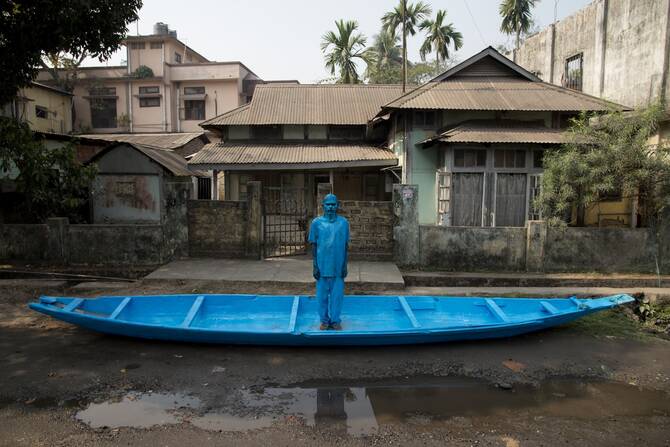
‘Man On Boat’

Devadeep Gupta
This is one of a series of photographs documenting a 2017 performance in which Gupta enlisted fisherman and daily-wage worker Ramu Chowdhury to be painted in a shade of blue that evokes the Brahmaputra River, and pose in various locations in the Indian city of Guwahati in a boat painted the same color. The Brahmaputra, a long transboundary river, is prone to “catastrophic seasonal flooding,” resulting in the displacement of the most vulnerable communities living on its banks, including in Guwahati, whose banks have long been a site of makeshift settlements for migrant workers and their families. “Here, the fisherman’s painted figure functions as a human marker of climate catastrophe, displacement and the contested right to remain,” the show notes say. “A year after the work took place, an Assam Government project cleared these settlements under the guise of beautification.”
‘Directions’

Mohammed Kazem
In his mid-twenties, the Emirati conceptual artist fell overboard during a solo fishing trip. “He was confronted by a boundless horizon and a total absence of navigational cues. He was eventually saved by a friend who used a GPS device — a rarity in the 1990s — to retrace the boat’s path and locate him in the open water. This event left the artist with a vision of the sea that was both grandiose and terrifying, sparking a lifelong obsession with the GPS system that saved his life,” the show notes state. “Following this experience, Kazem has continued to use numerical sequences not just as data, but as a canvas and medium,” as in this work from 2002, consisting of photographs and video documenting Kazem throwing coordinates carved out of wood to float in the Arabian Sea, a site that “evokes a long and fluid history of trade across the Indian Ocean.”
‘Toxic Dreams’

Tatyana Zambrano
The Colombian artist created a video game in 2023 that “explores the entanglement of the informal economy and luxury automobiles in her home country,” where “SUVs such as the iconic Mercedes G-Wagon serve as potent symbols of status, luxury and excess, far beyond the functional use of the automobile.” The purchase of these vehicles is “often funded by the informal economy, where luxury goods become instruments for money laundering, a process from which corporations — such as European automakers — ultimately benefit,” the show notes explain. In Zambrano’s game, players navigate a carwash for luxury SUVs, the objective being “to ‘cleanse’ funds, transforming ‘dirty’ money into legitimate capital.”