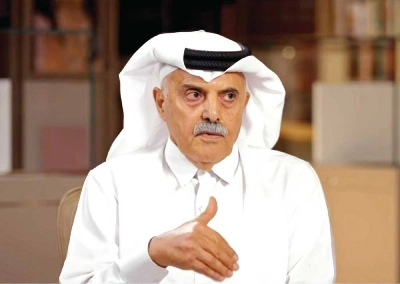
His Excellency Abdullah bin Khalifa al-Attiyah, Chairman of the Board of Trustees of Qatar National Archives, has shared personal reflections on his nearly 65-year relationship with His Highness the late Father Amir, Sheikh Hamad bin Khalifa al-Thani, describing it as a lifelong journey that began in childhood and continued throughout every stage of their lives. Speaking during an interview on Qatar Television, HE al-Attiyah recounted the close bond he shared with the Father Amir, beginning as classmates and family friends, and evolving into lifelong companionship and a professional partnership. He explained that his relationship with HH Sheikh Hamad started at an early age, initially through family ties rather than school, before becoming a daily companionship during preparatory school, where they studied in the same class, attended the same school, and belonged to the same circle of friends. He said their relationship later extended into public service, with him serving for many years as director of HH the Father Amir’s Office before assuming the position of Chief of the Amiri Diwan. He stressed that the qualities for which HH the Father Amir became widely known were already evident during his youth. Leadership, courage, determination, and a strong sense of responsibility were integral aspects of his personality from an early age rather than characteristics acquired later in life. According to al-Attiyah, HH Sheikh Hamad consistently demonstrated unwavering commitment to his principles, remaining steadfast in his convictions despite challenges throughout his youth, his years as ruler, and until his passing. Above all, HH the Father Amir’s primary concern was always Qatar and its people. He noted that HH Sheikh Hamad consistently placed the interests of the nation above his own health and personal time, believing he had a mission to accomplish for his country. Recalling one memorable incident, he said that he once entered HH the Father Amir’s office to discuss official matters and found him holding a sheet of paper on which only four words had been written: “Gas, Education, Health, and Sport.” Curious about their meaning, al-Attiyah asked HH the Father Amir to explain. HH Sheikh Hamad responded that all four sectors ultimately depended on natural gas, explaining that meaningful investment in education, healthcare, and sports required the financial resources that would be generated through the development and commercialisation of Qatar’s gas reserves. Al-Attiyah explained that although the vision to invest in natural gas had emerged at an early stage, significant challenges stood in the way. At the time, the international gas market lacked the importance and commercial appeal enjoyed by the oil industry, and few companies were willing to invest in gas projects. Nevertheless, HH Sheikh Hamad remained committed to the vision, eventually overcoming those obstacles. The revenues generated from Qatar’s gas industry subsequently became the financial foundation for national development projects across education, healthcare, sports, culture, media, and numerous other sectors. Turning to another defining milestone, al-Attiyah discussed the decision to abolish the Ministry of Information. He revealed that HH the Father Amir had contemplated the decision for around a year before implementing it, discussing the proposal privately with a limited circle of trusted advisers. He stressed that abolishing the ministry was far from a routine administrative reform, as it represented a bold transformation in the Arab media landscape. At that time, government ministries of information served as the principal source of news across much of the Arab world, making the decision to replace that model with a different media approach both unprecedented and highly significant. Reflecting on HH Sheikh Hamad’s early ambitions, al-Attiyah said that even during preparatory school, HH the Father Amir possessed a clear vision for Qatar’s future and expressed a strong desire to serve the country. He frequently spoke about Qatar’s development and believed that one day he would occupy a position from which he could influence the nation’s future and serve its people. HE al-Attiyah also highlighted humility as one of HH the Father Amir’s defining characteristics, stressing that power and leadership never altered his personality. Whether in formal gatherings, public markets, or everyday settings, HH Sheikh Hamad remained approachable, greeting people of all ages warmly and using familiar local expressions that endeared him to citizens and residents. The interview also included several examples illustrating HH the Father Amir’s exceptional loyalty. Al-Attiyah recalled that upon learning of the death of his former teacher, Ahmed Mansour, HH Sheikh Hamad personally traveled to Egypt to offer condolences to the teacher’s family, describing the gesture as a reflection of his gratitude toward those who had influenced his life. In another example, al-Attiyah recounted that when one of their former classmates passed away in Dubai decades after their graduation from secondary school in 1968, HH the Father Amir immediately requested to travel there. Accompanied by al-Attiyah, he visited the deceased’s family, spent nearly an hour with his children, shared memories of their father, and recalled stories from their school days despite more than 20 years having passed since they had last met. According to al-Attiyah, such deeply human gestures removed any sense of formality experienced by those meeting the Father Amir for the first time. Despite being the nation’s leader, he treated everyone with simplicity and warmth, making people feel they were speaking with an ordinary individual rather than a head of state. Whether interacting with family members, friends, employees, or members of the public, he maintained the same respectful and approachable manner. Al-Attiyah stressed that Qatar and its people always remained HH Sheikh Hamad’s foremost priority. From an early stage in his life, he devoted every effort to advancing the country, often at the expense of his own health. He closely followed every issue concerning Qatar, consistently striving to improve citizens’ quality of life while also caring for the welfare of expatriate residents, although the people of Qatar always held a special place in his heart. He further observed that the profound affection the Qatari people held for HH the Father Amir became especially evident upon his passing, when families across the country felt as though they had lost one of their own. Al-Attiyah described Sheikh Hamad as someone who loved people without distinction and possessed an extraordinary memory for those he had encountered throughout his life. During public events, he would often recognise individuals from a distance, ask to meet them, and remember that they had studied together decades earlier, whether they were Qataris or members of expatriate communities. This human touch was equally reflected in his daily work schedule. While serving as director of the Father Amir’s Office, HE al-Attiyah said official appointments would often be expanded at HH Sheikh Hamad’s request to include people he had not seen for many years. As a result, meetings frequently increased from four or five appointments to nine or 10 in a single day. Nevertheless, HH the Father Amir would receive visitors continuously from early morning until the afternoon prayer without showing any signs of fatigue, demonstrating remarkable stamina, patience, and dedication to serving people. Al-Attiyah described HH the Father Amir’s personality as an exceptional model worthy of academic study, stating that future generations should examine his character, leadership, and achievements. He characterised HH Sheikh Hamad as a school of ethics, humility, political leadership, national accomplishment, and patriotism, noting that his achievements constituted one of the brightest chapters in Qatar’s modern history. He also observed that HH the Father Amir frequently reflected upon the legacy of Qatar’s founder, Sheikh Jassim bin Mohamed bin Thani, drawing inspiration from the nation’s historical foundations. Discussing HH the Father Amir’s final advice urging the people of Qatar to remain steadfast in truth and righteousness, al-Attiyah said those words perfectly reflected principles that HH Sheikh Hamad had embraced throughout his entire life. He also recalled that HH the Father Amir cherished memories of his preparatory and secondary school years until his final days, maintaining an extraordinary memory that enabled him to remember faces, events, and friendships from every stage of his life. Illustrating this loyalty, al-Attiyah recalled informing Sheikh Hamad that one of their former classmates had passed away years earlier and that his children had since lost contact with the community. HH the Father Amir immediately replied, “No, that is not right. He was our friend. Ask about his children,” demonstrating that he never forgot those with whom he had shared life's journey. Speaking emotionally, HE al-Attiyah admitted that HH the Father Amir’s passing was deeply painful and difficult to comprehend. For days afterward, he found himself instinctively referring to Sheikh Hamad as though he were still alive before realising the reality of his loss. He added that although their educational paths later took them to different countries — with Sheikh Hamad attending military studies in the United Kingdom and al-Attiyah studying in the United States — their friendship never diminished, as they remained in contact through letters, some of which he still preserves today. Concluding the interview, HE al-Attiyah described HH the Father Amir’s passing as an irreplaceable loss, praying that Allah grant him His mercy and eternal paradise. He also expressed his belief that Sheikh Hamad’s defining qualities of humility, generosity, and closeness to the people continue under the leadership of His Highness tthe Amir Sheikh Tamim bin Hamad al-Thani, noting that these qualities have strengthened the bond between the country’s leadership and its people. He concluded by praying for the continued security, stability, and prosperity of Qatar.