



The shore strikes back: The demise of gunboat diplomacy

https://arab.news/bg82w
For nearly two centuries, gunboat diplomacy was the blunt instrument of empire. A warship appearing off a weaker nation’s coast was not merely a show of force — it was a verdict. Resistance was futile. Geography and technology combined to make submission the only rational option.
From Lord Palmerston’s gunboats battering concessions out of Qing China during the Opium Wars to Commodore Matthew Perry’s black ships forcing Japan open in 1853, naval power projection became the mechanism through which the strong dictated terms to the weak. The logic was brutally simple: the shore was defenseless and the sea belonged to whoever possessed the largest fleet.
That era is ending.
Not with a treaty. Not with a dramatic surrender ceremony. But with swarms of cheap drones crossing the Arabian Gulf.
The spring 2026 war between the US and Iran may ultimately be remembered less as a regional conflict than as a historic military demonstration. It provided the world’s armed forces with an unprecedented real-world laboratory — and its conclusions have unsettled admirals and defense planners from Washington to Beijing.
Iran was never a peer competitor to the US. American and Israeli strikes devastated large sections of Iran’s air defenses, damaged its naval infrastructure and crippled parts of its missile production network. Measured conventionally, the imbalance in military capability was overwhelming.
And yet the campaign failed strategically.
Iran was not brought to its knees. It did not capitulate. It did not sue for peace on Israeli and American terms. Instead, it retaliated asymmetrically — and expensively enough for the attackers to make continued escalation politically unattractive.
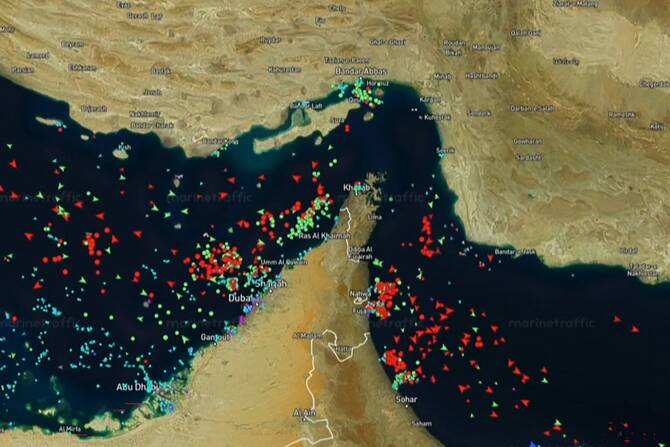
Iranian missiles and drones struck American facilities across the region, including the headquarters of the US Fifth Fleet in Bahrain. Reports indicated that repeated attacks rendered several bases in other Gulf countries effectively unusable, forcing evacuations, remote operations and costly defensive redeployments. Estimates from the Center for Strategic and International Studies placed the value of total American equipment losses in the billions of dollars.
The significance of this is difficult to overstate. The most powerful military machine in human history struggled to protect its own military bases and a vital international waterway from a country whose economy is smaller than that of many individual American states.
Even a fourth-tier military equipped with guided drones and ballistic missiles can now impose unacceptable costs on a superpower
Nabil Al-Khowaiter
The reason lies in the brutal arithmetic of modern precision warfare.
A ballistic missile or one-way attack drone costing tens of thousands of dollars can destroy aircraft, radar systems and surface ships worth billions. At those exchange rates, the weaker side no longer needs to win outright. It only needs to make victory unaffordable.
That is a military revolution whose impact has still not been fully appreciated by most military leaders around the world.
Drones also gave Iran the power to close the Strait of Hormuz and throw global energy markets into turmoil, which created immediate political pressure far beyond the battlefield. Eventually, it was Washington — not Tehran — that reached for de-escalation. The US invoked the War Powers Act, then announced hostilities concluded and pivoted back toward diplomacy.
And in doing so, the old logic of gunboat diplomacy quietly collapsed.
For two centuries, great powers assumed naval supremacy could compel political submission short of total war. The Iran conflict demonstrates something profoundly unsettling: even a fourth-tier military equipped with guided drones and ballistic missiles can now impose unacceptable costs on a superpower. This change in the power balance between the weak and the strong is comparable to the change in the power balance in late medieval Europe between the armored knight, who had ruled the battlefield for centuries, and the foot soldier who was armed with first a crossbow and later gunpowder weapons.
The most consequential lessons of the Iran war may ultimately be learned not in Washington or London but in other points of tension around the world between larger and smaller states, like the Taiwan Strait and the Indo-Pakistan border.
Taiwan’s strategic position has always been unforgiving: a small island facing a vastly larger continental power capable of absorbing enormous losses and trying again. Every conventional platform Taiwan purchases — tanks, destroyers, fighter aircraft — is expensive, visible and vulnerable to China’s industrial scale.
Taiwan cannot outbuild China. It cannot outspend China. It never could. But the drone revolution changes the equation. Taiwan does not need military parity. It needs denial.
Its objective is not to destroy China militarily but to make invasion politically intolerable before military success becomes possible. This is the logic of the so-called porcupine strategy — a smaller power survives not by overpowering a predator but by making every attempted attack unbearably costly.
You do not need to sink the entire invasion fleet. You only need to sink enough of it.
Enough ships. Enough helicopters. Enough transport vessels. Enough soldiers in the opening days of an invasion that the political cost for Beijing becomes impossible to justify.
Cheap, dispersed, artificial intelligence-assisted precision drones are almost perfectly suited to this strategy.
The Taiwan Strait is about 126 km wide at its narrowest point. Any invasion force must spend hours exposed while crossing it. Every troop ship, amphibious landing craft and transport helicopter becomes a target for swarms of drones launched from concealed positions across the island.
And unlike traditional military infrastructure, drone launch systems are difficult to eliminate completely. You cannot destroy every mobile launcher, tunnel system or hidden stockpile before landing troops. And you cannot land troops without first crossing the strait. The attacker becomes trapped in a vicious circle.
A Taiwanese porcupine facing a Chinese tiger. The tiger may still kill the porcupine — but not without paying dearly.
Aside from changing the balance of power in ongoing or potential conflict zones around the world, this latest Arabian Gulf drone war will invariably lead to a paradigm shift in sea warfare.
The aircraft carrier is not obsolete yet. But its strategic clock is ticking.
This vulnerability did not emerge suddenly. Naval strategists have worried privately for decades about the growing mismatch between increasingly expensive surface ships and increasingly cheap precision weapons. What the Iran war has changed is scale. Theoretical vulnerability has become demonstrated vulnerability.
The economics are devastating.
A modern Nimitz-class aircraft carrier costs about $13 billion to construct. It requires a crew of some 5,000 personnel and depends upon an escort fleet of destroyers, submarines, logistics vessels and surveillance systems to survive in contested waters. It is not merely a ship; it is an entire floating ecosystem — and a catastrophic single point of failure.
Against it, an adversary can deploy hundreds of disposable attack drones at a tiny fraction of the cost.
Cheap, dispersed, artificial intelligence-assisted precision drones are almost perfectly suited to this strategy
Nabil Al-Khowaiter
The mathematics favor the attacker. The defender must intercept nearly every incoming threat. The attacker needs only a handful to get through. A few successful strikes on a flight deck could neutralize a vessel that took years and billions of dollars to build. That exchange ratio is impossible to sustain indefinitely.
As long-range drones become cheaper, more autonomous and more widely available, the carrier’s strategic utility narrows dramatically. Carriers will still dominate conflicts against opponents incapable of reaching them. But against any technologically competent adversary, they risk becoming liabilities rather than assets.
The carrier has powerful defenders: admirals, shipbuilders, defense contractors, congressional districts and decades of institutional doctrine built around its supremacy. But history is not sentimental toward prestige platforms.
And as the logic of surface dominance weakens, the submarine’s strategic importance rises.
That transition is already visible. The AUKUS agreement — under which the US and the UK are transferring nuclear-powered submarine technology to Australia — represents one of the most significant naval technology transfers in decades. Beneath the diplomatic language lies a simple strategic judgment: the submarine, not the carrier, is becoming the decisive capital ship of the coming era.
Submarines possess advantages surface fleets cannot replicate in the drone age. They are difficult to detect, difficult to target and largely immune to the aerial saturation attacks that threaten surface vessels. A carrier broadcasts its presence. A submarine conceals it. A destroyer announces escalation by appearing off a coastline; a submarine can sit silently offshore for weeks without triggering a political crisis.
Most importantly, underwater warfare presents technological challenges that remain extraordinarily difficult to solve.
Autonomous underwater vehicles will eventually threaten submarines, just as drones threaten surface ships. But underwater autonomy is vastly harder than aerial autonomy. Radio waves do not travel effectively underwater. Communication is slow, unreliable and detectable. An underwater drone cannot rely on constant remote guidance; it requires genuine independent decision-making in one of the harshest operating environments on Earth.
That engineering problem may take decades to solve fully. Which means the submarine will likely enjoy a long strategic window of relevance — perhaps the final dominant platform of the late industrial military age before autonomy reshapes warfare yet again.
The decline of the carrier, the resurgence of the submarine and Taiwan’s likely turn toward asymmetric defense are all expressions of the same underlying transformation: precision munitions at scale are breaking the coercive monopoly of expensive platforms.
This is not a minor tactical shift. It is a military revolution on the scale of gunpowder, railways or air power itself.
For centuries, military dominance depended upon concentrating industrial power into increasingly massive and expensive systems: battleships, carriers, bomber fleets, armored divisions. Precision drones reverse that logic. They disperse lethality. They democratize reach.
And every small or medium-sized state facing a stronger neighbor will draw the same conclusion.
The age in which a great power could simply anchor a fleet offshore and dictate political terms rested on one foundational assumption: that the weaker side could not strike back effectively. That assumption is dissolving. Not everywhere. Not immediately. The US will remain the world’s dominant military power for decades. But the trajectory is unmistakable.
The states that adapt fastest — building around cheap, abundant, precise and distributed weapons rather than concentrated prestige platforms — will solve the defining military problem of the 21st century: how the weak survive against the strong.
The gunboat worked because the shore was defenseless. The shore is defenseless no longer. And that changes everything.
- Nabil Al-Khowaiter is a former senior adviser to the Saudi minister of energy.