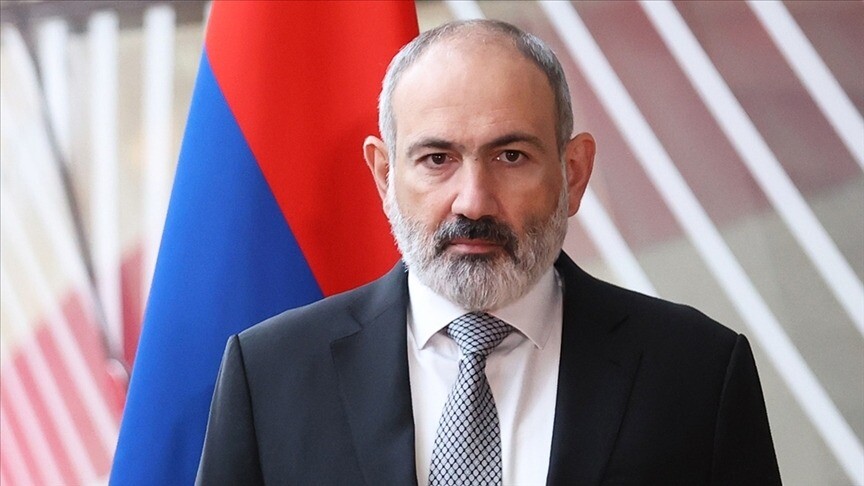
- These elections are a referendum on how the peace process and foreign policy are being perceived by the public, Sargis Khandanyan, chair of Armenia’s Standing Committee on Foreign Relations, tells Anadolu
- Ruling Civil Contract party leads comfortably in the polls against a fragmented, pro-Russian opposition
On June 7, Armenia will hold what could be its most consequential election since gaining independence.
The parliamentary vote is widely seen as a referendum on Prime Minister Nikol Pashinyan’s agenda of regional reconciliation, economic integration and his controversial “Real Armenia” doctrine.
Pashinyan’s Civil Contract party has actively championed regional integration, peace with Azerbaijan, and the normalization of ties with neighboring Türkiye.
“These elections are a referendum on how the peace process and the foreign policy” are being perceived by the public, Sargis Khandanyan, chair of Armenia’s Standing Committee on Foreign Relations, told Anadolu.
He predicted the ruling Civil Contract will emerge as the winner following the election.
Khandanyan pointed to the tangible outcomes of the peace efforts, stating: "We said there will be peace, and since the last nine months, we can see that peace is very substantial.”
“We will work on institutionalization of this by pushing on a silent peace agreement with Azerbaijan and ratification of it," he added.
Maria Karapetyan, a member of Armenia's parliamentary standing committee on foreign relations, echoed these sentiments, highlighting that the upcoming public vote will endorse the newly established regional security architecture.
"These are extremely important elections," Karapetyan told Anadolu. "We will find out whether the people of Armenia approve the peace architecture that we have put in place for Armenia and the South Caucasus, and our belief is that they will."
Karapetyan emphasized that the ruling party promised the public two main objectives during its outgoing tenure: "opening an era of peace for Armenia in the region, and... a stronger sense of rule of law within Armenia."
According to her, the administration has successfully delivered on both of these promises.
What is 'Real Armenia'?
"Real Armenia," the brainchild of Pashinyan, is a concept that encourages citizens to focus on the country’s actual, internationally recognized territory rather than historical aspirations.
"We have this concept of real Armenia … We do not need to look outside of our borders, because when we look outside of our borders, others also look inside our borders, and we need to stop," Khandanyan said.
We must "focus on 29,743 square kilometers of territory of the Republic of Armenia, which is that yellow ethical ledge that we wear,” he said.
The "yellow ledge" refers to the internationally recognized sovereign territory of Armenia.
Public office holders in Armenia wear this map as a golden-yellow lapel pin.
It was also distributed to the public, as a powerful reminder to abandon expansive historical claims and focus entirely on the country's legal borders.
Despite domestic challenges and criticism, Pashinyan has remained steadfast in his pursuit of normalization. He previously stated that he will not give up on his vision of peace and open borders.
To consolidate this vision and finalize the peace process with Azerbaijan, the government is seeking a constitutional majority to draft a completely new Constitution.
Karapetyan said that previous referendums in Armenia were often conducted under suspicious circumstances, and that a new referendum and Constitution are needed that are “adopted legitimately and without any doubts.”
But to put a new Constitution to a public referendum, Pashinyan’s party must win a two-thirds constitutional majority in the upcoming election, a goal that analysts describe as a highly challenging task.
The primary change in the new Constitution will be the removal of references to the 1990 Declaration of Independence, which calls for unification with Azerbaijan’s Karabakh region, to satisfy Baku’s key precondition for signing the peace treaty, alongside internal reforms designed to decentralize power and grant parliament greater oversight mechanisms over the prime minister.
Fragmented opposition
Despite the high stakes, Pashinyan's Civil Contract party leads comfortably in the polls against a fragmented, pro-Russian opposition.
According to the latest International Republican Institute (IRI) and EVN Report surveys, Civil Contract garners 24% to 26.1% of voter support.
Its main challenger, the Strong Armenia party, led by billionaire Samvel Karapetyan, who is currently under house arrest on charges of inciting a coup, lags behind at 9% to 11.9%.
Meanwhile, former President Robert Kocharyan's Armenia Alliance polls at just 3% to 3.3%, struggling to clear the 8% threshold required for electoral alliances.
Crucially, nearly 30% of the electorate remains undecided, representing the ultimate kingmakers of the June 7 vote.
Unlocking regional connectivity
The peace process is closely tied to economic connectivity, particularly the US-facilitated Trump Route for International Peace and Prosperity (TRIPP) transport corridor, designed to link mainland Azerbaijan with its Nakhchivan exclave through southern Armenia.
At a White House summit in August 2025, hosted by US President Donald Trump, Pashinyan and Azerbaijani President Ilham Aliyev signed a peace agreement.
Trump subsequently witnessed the signing of the Joint Declaration, establishing the basis for bilateral and international transportation.
Karapetyan described this as a major breakthrough.
Armenia will "work hard on connectivity with the TRIPP project," while simultaneously pursuing normal ties with Ankara, she said.
Armenia’s normalization process with Türkiye is shifting from cautious diplomacy to concrete economic steps.
On May 11, both nations finalized bureaucratic preparations to launch direct trade, allowing goods transiting via third countries to directly designate "Türkiye/Armenia" as their origin or destination.
Additionally, Turkish Deputy President Cevdet Yılmaz and Pashinyan signed a historic memorandum of understanding to jointly restore the Ani Bridge on their shared border.
"I believe that there is no obstacle between Armenia and Türkiye to normalize the relations, and for Türkiye to open its border," Khandanyan said.